


End of Abyss Review - Sci-Fi Survival Horror Meets Metroidvania Madness!

Earlier this year my hype for Reanimal, the spiritual successor to the Little Nightmares franchise made by the original team at Tarsier Studios, was through the roof. As a big fan of Little Nightmares 1 & 2, I was eager to see how Tarsier could evolve its horrific and creatively atmospheric design into the third dimension. And while it hurts to openly say how disappointing I found it without clarifying that I still enjoyed myself overall, its perspective took a step forward while the gameplay took a few steps back, relying so heavily on clumsily-scripted trial-and-error sequences that it felt outdated from the start. As nearly-perfect as the game's horror vibes were, its gameplay felt like a hindrance rather than a natural fit, leaving me to feel like its best ideas could have been a movie.
And so I was left hesitant about the future of this strange, delightfully terrifying subgenre of horror. On paper, End of Abyss feels like just the remedy I'm looking for - an equally atmospheric horror title that mashes the grimy, cinematic vibe of Little Nightmares into a full-fledged metroidvania with actual combat mechanics. And who better to take it on than the folks at Section 9 Interactive, a Swedish indie studio led by some former Tarsier developers? Arguably, nobody. But whether End of Abyss paves its own identity apart from its spiritual predecessors is exactly what we’re here to talk about.
And the answer is… yes?... with the meaningful caveat that it may depend what you're looking for. Even for a genre as saturated as the metroidvania, End of Abyss feels undeniably fresh - a gorgeous, lonely, oppressive adventure full of exploration, tense combat encounters and enemies like a giant human hand with legs that can tackle you to the ground if you don't dodge it quickly enough. Not the way I was looking to get fingered today, thank you very much!
You play as Cel, a technician tasked with exploring a massive facility full of hostile, mutated monstrosities. As with Little Nightmares, the plot is delivered in vague strokes that prioritize atmosphere over explicit storytelling, which thankfully works just as well here to create a mysterious vibe with a constant undertone of unmistakable wrongness. Unlike Little Nightmares, End of Abyss quickly establishes itself as a non-linear, gameplay-focused experience emphasizing careful exploration, for better or worse.

In that sense, it may be easy to think of End of Abyss as Little Nightmares in vibes, but closer to the older Resident Evil titles in structure, albeit without the clunky tank controls or obtuse puzzles (thank god). Each explorable area has plenty of locked doors, inaccessible ladders and sections to later return to, and paving your path forward while seeing these shortcuts unfurl is extremely satisfying, with tight level design that aims to reward you for exploring properly whenever it can. One of my favorite aspects was doors that are locked by energy nodes, which you have to use your scanner to trace out to different parts of the room before shooting them to gain access.
The scanner is one of the more unique aspects of End of Abyss, especially in its visual presentation. Turn it on and a collection of blue lasers shoot outward, seeking every nook and crevice in the otherwise dim and dilapidated environments to highlight item boxes, vents, locked doors and enemy types. You'll learn to rely on this scanner a lot as you play, especially since it's the way you'll populate your map with the locked areas you'll need to return to later.
I'm torn on this approach myself, for a few reasons. For one, while the visual presentation of the scanner looks undeniably cool in a way I never got tired of, using it requires you to walk extremely slowly, and I could never help but feel that seeing a locked door and needing to break out the scanner to register it on the map felt like an unnecessary extra step. And for another, the map itself currently has an extremely irritating bug where locked doors will sometimes continue to appear locked even once you've gone through them, making the map feel like you have to see through its lies in order to properly understand which areas you still need to explore. Hopefully a patch is issued soon but in the meantime, I highly recommend using custom map markers for this, though admit the fact that it only has one type of custom map marker is a little disappointing coming off of my last review, Well Dweller, which gave the player several different icons to mark unique points of interest.
None of this was a big deal at first until one point in my playthrough where I walked around for over an hour having no idea where to go next, facing the same enemies repeatedly until just running past them felt like the most efficient route. Turned out I had missed scanning a ventilation shaft that was required to progress, and to say I was unhappy about this, especially since that shaft was obscured by breakable boxes I just happened to not notice, would be to put it mildly. I'm no stranger to butting heads with metroidvanias that make navigation into its own challenge, but if that's something that bothers you too, be aware that there is very little guidance here, for better or worse, depending on your preferences.
I'd even say these navigational woes are where much of the game's difficulty comes from, since combat, while feeling tight and snappy in exactly the right way for a game like this, rarely pushes you hard enough to feel in genuine danger outside of the game's boss encounters. Cel is pretty well equipped with an upgradeable pistol that has unlimited ammunition, a dodge roll that makes getting out of danger’s way a breeze, and a number of other limited-ammunition weapons and grenades. The other weapons were pretty cool, but sadly I rarely felt a genuine incentive to use them. In most cases they rarely felt much more powerful than the pistol (especially once you unlock its charge shot) and their precious limited ammo needs to be crafted at save points and doesn't come back after failed attempts, giving the game a sprinkle of soulslike flair in, arguably, the wrong place.
I did enjoy the combat quite a bit, though. It functions as almost a twin stick shooter but slower and far more deliberate. Cel’s aim feels shaky, adding incentive to get closer to enemies to make sure your shots land. And even with the pistol, there's a tense trade-off in waiting for a charge shot to go off versus dodge rolling out of harm's way. And while the standard enemies rarely backed me into a corner or killed me, I certainly had to pay attention when swarms of them would come at me at once. Despite the combat's lack of true difficulty for much of the time, the enemies attack so quickly and viciously that you still have to pay attention if you hope to succeed.
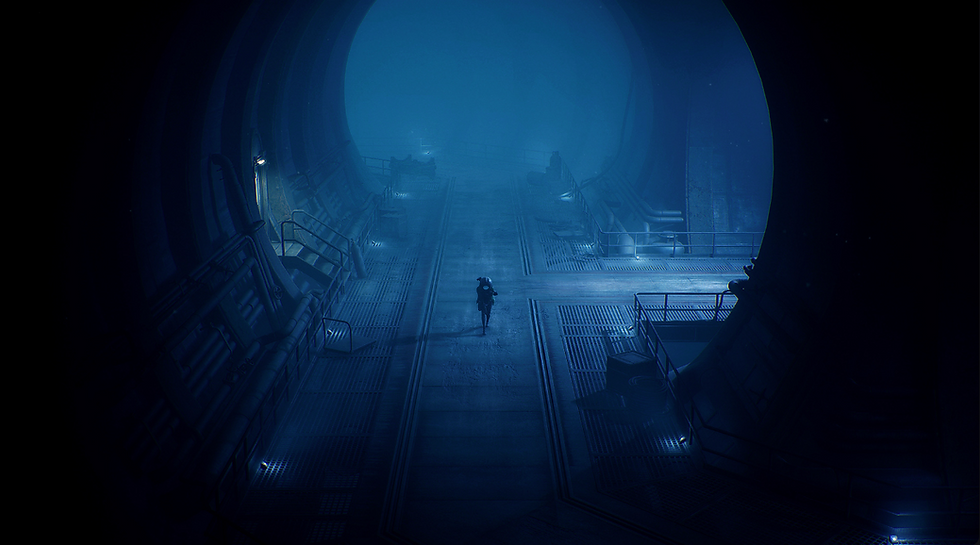
A lot of that tension is bolstered by the game's phenomenal presentation. If you've played Little Nightmares, you'll know exactly what to expect here. Environments feel simultaneously barren and like they're watching you, waiting for the right moment where you turn your back. Every location drips with rot and despair, with phenomenal sound design pulling your attention toward every enemy grunt or unexpected movement around you. The tension is there and it's phenomenal, but rarely progresses into full-fledged fear. This is undoubtedly a horror game, but one that's much more keen to immerse you in a constant sense of unease rather than resort to jump scares or chase sequences. And because of this and the way Cel is well-equipped compared to her miniature counterparts in Little Nightmares, I wouldn't expect a ton of scares. It's disturbing, it's compelling and it's brilliantly atmospheric, but it's not especially scary. Not a huge problem as I see it, but worth noting given the season we're in and the types of games some people are looking to play.
In the end, I think Section 9 Interactive has accomplished something tremendous here. End of Abyss, for all its flaws, is one of the most memorable games of 2026 and a fantastic debut for the studio. Even when I was frustrated or annoyed by it, I still didn't want to put it down because the game feels like significantly more than the sum of its parts, largely due to how immersive and rewarding it is. Ultimately, it feels like a great game that fast-walks so that an eventual sequel can run by polishing off some of its pricklier edges to a fine shine. But then again, some of that prickliness in a horror game is undeniably part of the charm. End of Abyss earns itself the Silver Genie Lamp of Approval.
Pros:
Stunning cinematic presentation
Feels like an evolution of Little Nightmares with deeper gameplay systems
Great level design
Combat feels frantic and punchy
Impeccable atmosphere
Cons:
Very little handholding means it's easy to get lost and wander aimlessly
Not much incentive to use limited-ammunition weapons
Map is occasionally unreliable
Despite oppressive atmosphere, rarely manages to be scary
Who's it for?
Fans of Little Nightmares and Reanimal who want more gameplay focus
Metroidvania fans

Comments